Contracts are the financial DNA of any organisation. They define obligations, shape revenue recognition, dictate payment terms, and allocate risk.
Yet, despite their criticality, management is often decentralised, fragmented and poorly monitored - causing high levels of contract risk in growing or complex enterprises.
According to Deloitte, 38% of CFOs express worry that strategy execution is an internal risk within their organisation, while 42% point to concerns around data compatibility and accessibility.
For CFOs, this can create a blind spot with real financial consequences. The outcomes are clear:
- Budget overruns
- Audit failures
- Vendor disputes
- Revenue leakage.
The common cause is an inability to see, assess and act on contract-related risk in real-time.
This article explores why CFOs must adopt a leadership role in transforming contract risk from a hidden liability into a source of strategic control.
It covers the most pressing risk factors, the benefits of a centralised and automated Vendor and Contract Lifecycle Management (VCLM) platform, and how modern CFOs can use VCLM tools to safeguard financial health and drive enterprise value.
The Hidden Contract Risks impacting your bottom line
The limitations of manual vendor and contract management are often exposed by the occurrence of operational inefficiencies, financial oversights and escalating risk.
The following recurring issues indicate an urgent need for attention:
- Missed Renewals and Unplanned Expenses: Contracts tucked away in spreadsheets or filing cabinets are easily forgotten. When auto-renewals occur without scrutiny, businesses may pay for products or services no longer needed, miss opportunities to renegotiate terms, or continue to do business with undesirable vendors. For CFOs, this translates to unnecessary costs and strained margins; for the operational stakeholders in such contracts, it can be a missed opportunity to explore more cost-effective solutions.
- Compliance Failures and Audit Gaps: Regulatory compliance depends on access to accurate, up-to-date contract data. Without a systemised approach, audit preparation becomes a scramble, increasing the risk of regulatory fines or reputational damage. Incomplete records or undocumented approvals can make it difficult to prove due diligence.
- Fragmented Vendor Oversight: Vendor contracts often contain clauses around performance targets, liability limits or specific deliverables. When these aspects are not centrally tracked, poor vendor performance can persist unchallenged, leading to lost value, legal exposure and operational disruption.
- Inaccurate Forecasting: Without visibility into upcoming obligations or milestone-based payments, CFOs struggle to forecast spend accurately. This can skew budget planning, cash flow management and investment decisions.
Building a CFO-Led contract Risk Framework
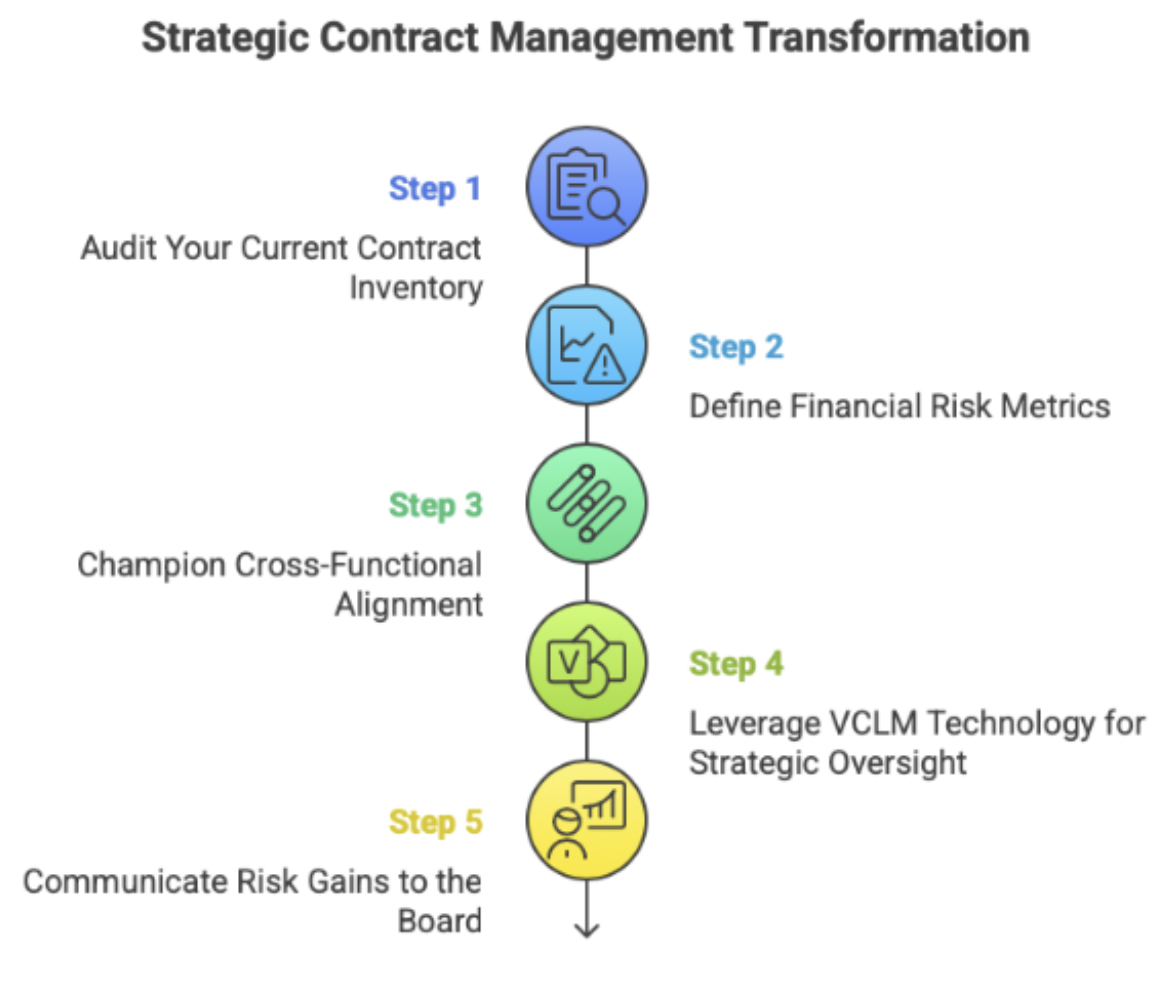
For CFOs ready to make changes, here’s a structured approach to transforming contract risk management from a reactive manual activity to a proactive automated system:
- Step 1: Audit Your Current Contract Inventory: Begin by discovering where your contract documents are located, how they’re approved, and who is responsible for key touchpoints. Identify the biggest sources of friction, risk or lost value.
- Step 2: Define Financial Risk Metrics: Establish contract-related KPIs relevant to finance, such as average contract value, missed renewal percentage, or time-to-contract. These metrics will help track improvements over time.
- Step 3: Champion Cross-Functional Alignment: Risk can’t be effectively and consistently managed in silos. Work with Legal, Procurement, Compliance and IT to ensure risk visibility and mitigation strategies are consistent across departments.
- Step 4: Leverage VCLM Technology for Strategic Oversight: Choose a VCLM platform like Gatekeeper that integrates with your existing systems such as NetSuite and provides built-in analytics, workflow automation, and risk insights about your vendors.
- Step 5: Communicate Risk Gains to the Board: Track and share improvements in visibility, efficiency and avoided costs. Quantifying the reduction in financial exposure will help reinforce the value of your investment and secure buy-in for broader digital transformation initiatives.
How to reduce contract risk with VCLM software
Gatekeeper’s VCLM platform helps CFOs strengthen financial control, reduce risk exposure, and increase operational agility by creating a single source of truth for all vendor and contract data. Here’s how it delivers measurable value:
- Real-time visibility to strengthen forecasting and budgeting: Gain immediate access to your full contract portfolio, including renewal timelines, financial commitments, payment milestones, and risk classifications. Centralised dashboards and AI-powered data extraction make it easy to identify liabilities, optimise spend, and build more accurate forecasts.
- Automated controls to prevent cost leakage and oversight: Intelligent alerts and best practice workflows ensure timely action on contract renewals, reviews, and vendor onboarding. This reduces the risk of value loss, missed obligations, and non-compliance, while aligning contract activity with financial planning cycles.
- Risk tiering that enables targeted oversight and resource allocation: Gatekeeper applies custom risk scores based on criteria such as contract value, geography, vendor performance, or industry. This allows finance leaders to prioritise reviews and audits based on actual exposure rather than treating all contracts equally.
- Built-in reporting to support faster, data-driven decisions: Access exportable reports and real-time KPIs, such as contract value, renewal pipeline, and time-to-contract, through configurable dashboards. These insights help CFOs inform boardroom discussions, respond quickly to emerging risks, and plan proactively.
- Policy-aligned workflows that enforce governance at scale: Rule-based approvals and pre-configured workflows ensure every contract follows a consistent, compliant path. Full audit trails, version history, and timestamped sign-offs reduce regulatory and reputational risk without introducing operational friction.
- Finance system integrations that ensure accurate data flow: Gatekeeper integrates with ERP and financial systems like NetSuite to sync contract data directly into your planning, procurement, and reporting environments. This improves data integrity, eliminates manual entry, and enhances cross-functional alignment.
How Redwood logistics Reduced contract risk with gatekeeper
Before Gatekeeper, Redwood Logistics managed contracts manually across siloed teams. Critical information was often lost, renewals were missed, and vendor spend lacked visibility, introducing financial and compliance risk.
Gatekeeper changed that.
By integrating Gatekeeper with NetSuite, Redwood gained:
-
Real-time contract visibility to track obligations, expiry dates, and vendor spend in one place
-
Automated alerts to prevent missed renewals and reduce cost leakage
-
Custom workflows to standardise approvals, enforce policy, and support compliance
-
Stronger vendor negotiations through spend analysis and performance tracking.
"The ROI is the visibility of the contracts and the actual spending."
With Gatekeeper, Redwood Logistics moved from reactive, manual processes to proactive contract management, reducing risk, cutting costs, and improving vendor performance.
Conclusion
Today the stakes are simply too high for CFOs to fail to give contract risk the attention it warrants. The consequences of such unmanaged risk can be devastating if not recognised and dealt with properly.
Taking ownership of contract risk is not just about prevention, it’s about unlocking control, and turning risk into resilience. With the right systems in place, contract risk becomes a managed variable, not an unpredictable threat.
By leveraging VCLM software like Gatekeeper, CFOs gain the tools to reduce hidden exposures, drive operational efficiency, and enable strategic forecasting.
Take control of contract risk today. Book a Gatekeeper demo and discover how our VCLM platform gives CFOs complete visibility, control, and confidence in contract and vendor risk management.



.png)
.png)
.png)
-4.png)